Thursday, July 17, 2008

Out of Nothing

Today's readings come from Is 10:5-7, 13b-16; Ps 94:5-6, 7-8, 9-10, 14-15; and Mt 11:25-27

As I was reading Jesus' words in the gospel today about the Father's revelation of his love and power to the "childlike," I was reminded of an event that happened during my time at Sarnelli House.

It was a cold, rainy, foggy, miserable day in Kensington—one of those days where you need only step outside and the cold penetrates right to your bones. It was a Tuesday, and on Tuesdays we would always let our guests from the streets come in to take a shower, get new underclothes, and whatever other types of clothing they might need. As our guests were filing in that Tuesday, though, I remember thinking to myself, "Y'know, I have to wonder why God allows this. I think if it were me out there in weather like this, I would just have to say to God, 'Take me… take me now, this just isn't worth it.'" As we prayed with our guests, the way we always began anything we did at Sarnelli House, Dennis, crippled years earlier when a bus had run over him, got up on his crutches to say, "I just want to thank the Lord for waking me up this morning and giving me another day of life." I knew that the best accommodations he had found the night before were probably a cardboard box. His prayer hit me like few other epiphanies ever have. He got it… he, this homeless man from the streets where the Rocky movies were filmed, had an understanding of God's love and providential care that far outstripped mine, a college graduate with a BA in Religious Studies.

Again and again we see this theme echoed throughout scripture: God works with nothing. Out of nothing, God brings good. Out of weakness, God brings strength. Out of humility, God brings honor. Out of emptiness, God brings love. Out of ignorance and meekness, God brings wisdom. This is what we hear Jesus saying in the gospel today and it is what we hear in the irony of the passage from Isaiah.

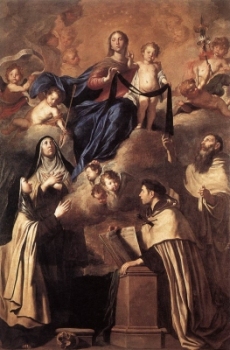
Today, we commemorate the appearance of Our Lady on Mt. Carmel. I think that oftentimes in the language of Marian devotion we lose sight of the full significance of Mary's virginity. God brought forth a child from a virgin. This is the example par excellence of God's method of working through human beings, bringing wonders forth from what they lack. In Mary's example, we see that God does not need our "help," at least as far as our accomplishments go, so much as he needs our openness to him—our openness to allowing him to supply everything we lack on our own.

For today, then, let us give some thought to our own weakness, emptiness, foolishness, and so forth, and ask the Lord, who loves us with an undivided heart, to give us the grace to be more open to him so that he might work his wonders through us. Let us also think about those ways in which perhaps we are over-confident in our own abilities, or proud of our own accomplishments, and ask God to help us see in what ways the things we "have to offer" might actually be getting in the way of the work God longs to accomplish through what we lack.

Glory to Jesus Christ! Glory Forever!

~J

Wednesday, July 9, 2008

Why Them? Why Me? Why us?

Today's readings come from Hosea 10:1-3, 7-8, 12; Psalm 105:2-7; and Matthew 10:1-7


It was just under a year ago that I was moving my things into the residence hall at Mundelein Seminary. Even though I had visited the campus twice before, this was my first opportunity to look at the little details. One of the things anyone notices once they start looking around is that the builders found a way to put a cross just about anywhere. They're on the doorknobs, the lampposts, the tops of the buildings, pretty much anywhere you look, basically. As joyously has I had received the Rite of Candidacy, and as happy as I was to be there with David and Michael, all I was saying to myself was, "What the *%&$# was I thinking to come here?! Let's see… I could probably get down to O'Hare pretty easily from here and jump a plane to… just about anywhere but here would do." Thankfully, I didn't run; I stayed and went through a period of adjustment during which God placed the right people in my life to say the right things at the right time.

One day, I was having a conversation with (now Father) Lance who lived across the hall from me. Lance was in his mid-late forties, had been and accountant, and at one time had even been the CFO of one the native tribes in Wisconsin. (Translation… high-powered job handling tens of millions of dollars.) We were discussing the questions that arise for a man as he goes throughout seminary formation: worthiness, feasibility, confusion, and so forth. He said to me,

Jay, I've become convinced that the Gospels are explicitly clear on these issues. Whenever I find myself asking the question, "Why am I here?" I remember the example of the apostles. Look at who Jesus picked to surround himself and carry out the mission of spreading the gospel: fisherman, laborers, a tax collector… not a single scribe or Pharisee among them. I'm sure that at the time, they had no idea why Jesus called them, but they persevered in a trust that they had some role to play in God's plan of salvation.

If you think about it, Jesus didn't say to Peter when he met him, "Come, follow me, I want you to be the head of the People of God in a new covenant that I am mediating between God and all of humanity." NO! I highly doubt that he would have gotten anywhere with that approach! All he said was, "Come, follow me." And Peter followed, putting one foot in front of the other, making mistakes, but eventually allowing God's plan for him to unfold over time.

We cannot know why it is that Christ chose those twelve men, including Judas, or why God chose Israel, or why the Spirit chooses us now. As we look at this week's readings from Hosea, it is abundantly clear that we all cause God no small amount of grief! Nevertheless, God has chosen us, and all he needs from us is our assent to put one foot in front of the other, following him each day until our role in his plan of salvation unfolds throughout our lives.

Glory to Jesus Christ! Glory Forever!

~J

Wednesday, July 2, 2008

Portraits of Fear


Today's readings are from Amos 5:14-15, 21-24; Psalm 50:7-13, 16-17; and Matthew 8:28-34.

Between the first reading today and the Gospel, we get two different portraits of fear—one is of healthy, genuine fear of the Lord, the other is unhealthy, a fear of God's love and power. In the reading from Amos, Israel is exhorted very harshly to cease and desist its evil deeds, namely the gross social injustice which it had allowed to run rampant in its society. We see a God depicted who is extremely dissatisfied with the state of this fledgling nation that he had brought up out of Egypt. In his anger, which seems to be the dominant theme of this week's Old Testament readings from Amos, God is ready, willing, and able to discipline his people. Note well, however, that discipline is always an outgrowth of love, and we are told that it is indeed out of his love for Israel that God plans such discipline.

Then on the other hand, in today's gospel we see the Gadarenes (or Gerasenes, if you have a different translation) who cannot get Jesus out of their territory fast enough after he exorcises the two possessed men. Jesus manifests his divine power to dispel the forces of evil in an act of profound healing, yet the people's response is one of fear. It is very clearly not the response Jesus was hoping for, yet what we see in the first reading today is essentially an exhortation to be afraid of God's power. Are you confused yet?

The key to understanding these contraries, notice I do not say "contradictions," lies in understanding the nature of God's love for us. God's love for us is multi-faceted; it both includes and transcends friendship, romance, respect, and yes, parental love. In our attempts to relate to God, we cannot forget that all of these elements must be present since it is through all of these ways, and then some, that God extends his love to us.

I can remember quite vividly "The Spoon" from my childhood. Yes, the infamous tool of discipline that was placed conspicuously within my mother's reach whenever I was getting just a little too uppity. I knew all too well why it was there and how it would be used if my behavior didn't change. However, I also remember just as clearly the cuts, scrapes, and bruises that my mother cleaned, bandaged, and kissed and the profound sense of being loved that those actions brought with them. Now, as an adult, I can look back even on "The Spoon" and see how loving the discipline was that I received as well.

What we see in the Gadarenes today is a rejection of the all-encompassing, multi-faceted love of God, namely its power to dispel evil and to effect enormous, life-altering transformations. What we cannot fail to miss in their example is just how natural it is to have such an adverse reaction to Love and how Jesus exhibits understanding and patience in the face of such a rejection. God understands that we are in need of growth and that human growth takes time. Nevertheless, what we cannot fail to take away from the first reading is that growth is not optional. God expects us to use the blessings of his love, not to squander them, and we will be held accountable for our use, or disuse, of what God has freely given. In his love, he reaches out to us—to heal and to discipline.

So for today, let's pray about those areas of our life where we have been resistant to some aspect of God's love for us, and ask him for the grace to open our hearts more to the love he wants to give us.

Glory to Jesus Christ! Glory forever!

~J