Sunday, October 26, 2008

A Type of the Priesthood

Readings for the 29th Sunday in Ordinary Time were from Is 45:1, 4-6; Ps 96:1, 3, 4-5, 7-8, 9-10; 1 Thes 1:1-5b; and Mt 22:15-21
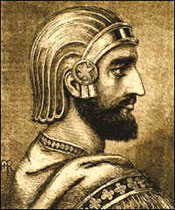
"I have called you by your name, giving you a title, though you knew me not."

My brothers, I am convinced that Cyrus is a type of our call to the priesthood. In the midst of the frustrations and busy-ness of these mid-term weeks, we must not allow ourselves to forget that it is the Lord who has brought us here, "though we knew him not."

Consider our lives in formation… where would we be if not here? I don't mean on the level of profession or educational track, married or not… these are not the truly important questions. The real question is, "Would I be on the path to holiness God even leveled for me, or down in the ditch with the devil?" "Would I be walking down the path of 'open doors and unbarred gates'—the path of the sacraments, of spiritual direction, of holy trial and self-discipline—or beating my head against the walls of regret, mediocrity, uncertainty, and the status quo?" I can certainly look back on my own life before I was a seminarian and see the possibilities, things I could have done… things I might would have liked to do… but that's all I see, only possibilities, only mere dreams and shadows of what I have actually done so far.

What was I before I was a seminarian? Well, St. Francis of Assisi liked to say, "What a man is in God's eyes, that he is and nothing more." So again, we must ask the question, "What would I be in God's eyes had I said 'no' to his call on my life to come to seminary?" "Would I be a useful servant?" "Whom would I be serving?" He is the Lord, and there is no other!

But we object, don't we?! We experience failures, we see our shortcomings, we come face to face with our utter unworthiness to be anything at all in God's eyes… and we 'praise' Jesus tongue-in-cheek like the Pharisees of this Sunday's gospel. "Jesus, you are truthful."—Yet you must have been trying to make me feel good about myself when you called me… "Jesus, you teach the way of God."—But I already know that I'm a useless pupil, a dunce, and unable to learn anything at all… "Jesus, you are not driven by human respect."—So you must have ignored all those people who remember just how selfish I used to be, how immoral, how ignorant… Jesus, are you sure you consulted enough before you called me? "Jesus, you take no notice of status."—Hmph. Obviously. All of this, brothers, is to forget the purpose of our call.

Our call is not for ourselves, it is for the People of God. Look back to Cyrus… why does God call him, a non-Jew? "So that toward the rising and the setting of the sun people may know that there is none besides me." Our formation for the priesthood is meant to be a wonder to behold, a miraculous feat of transformation from sinner to saint, from selfishness to self-sacrifice. God has called us—precisely—to demonstrate his power so that when the course of our lives is considered, all will truly say to the Lord, "You are God and there is no other… There is none other who grasps us by the hand."

Glory to Jesus Christ! Glory Forever!

~J

Saturday, October 18, 2008

The Kingdom of God and High-school Nightmares

This Past Sunday's Readings were from Is 25:6-10a; Ps 23:1-3a, 3b-4, 5, 6; Phil 4:12-14, 19-20; Mt 22:1-14 or 22:1-10


I have yet to encounter anyone who hasn't, at some time or other, been plagued by the nightmare of showing up at school clad in nothing but their underwear. (Or at least some permutation of that dream) I had these dreams for years in one form or another, and what I find striking about them in retrospect, particularly the nightmares I would have about school, is that they never had anything to do with being unable to do schoolwork. I never dreamt about not knowing how to spell a word, do a math problem, or botching a report in front of the class. Instead, the nightmare always entailed doing something right, achieving some little success, only to turn to my classmates and find that "mysteriously" there was nothing between me and their penetrating stares except some Fruit of the Loom. Usually, it was at this point in the dream, as all my classmates started pointing and laughing, that I would remember I had indeed neglected to put on all of my clothes before leaving the house that morning. These kinds of dreams express something critical about the real world: true preparedness has more to do with the context of a job than with the task at hand itself.

This is what I see as the thrust of this Sunday's readings. What we see in the gospel today, for instance, is that there really is no moral pre-condition for an invitation to the wedding feast. The king's men go out and bring in everybody—the good, the bad, and most assuredly, the ugly. At the wedding feast of the king's son, it is the future of the realm that is at stake. It makes sense, then, that the current state of the guests invited is of less importance than their potential—whether or not they are prepared to enter into the celebration properly. Out of the entire motley crew the servants gather in, only one has utterly missed the point and, with no excuse, has neglected to wear the proper attire. This one's failure is not any different than the failure of all those who previously rejected the king's invitation and killed his messengers. The gospel says, "Some ignored the invitation and went away, one to his farm, another to his business." We see in these poor people the tragedy of getting so entangled in the web of one's everyday affairs that the ultimate purpose of all work—the kingdom—gets forgotten.

Now, the paradise Isaiah describes for us today is nothing else than the ultimate fulfillment of God's grand design of salvation. This, is the end for which we are all destined. All of our undertakings, all of our concerns, our struggles, trials, and successes are means to that final end at best and distractions from it at worst.

Here at Mundelein, we are like that motley crew gathered in by the king's servants. We come here, from all walks of life, from all situations and backgrounds. Not one of us is here because he was "worthy" as his vocation director found him but because he showed some promise of becoming so. The challenge at hand, then, is whether or not we are properly open to be formed here at seminary. At the core of what we do here we find theology, prayer, pastoral work, and the like. But just as it is totally inappropriate for one to do arithmetic, spelling, or whatever, in grammar school dressed in his underwear can we undertake our responsibilities here without the faith that our ultimate destination is to be servants at the eternal wedding feast. This is the context of our work. This faith, this knowledge, this hope, is our garment of preparedness.

Glory to Jesus Christ! Glory Forever!

~J

Sunday, October 5, 2008

Where Do Great Priests Come From?

Today's readings are taken from Is 5:1-7; Ps 80:9, 12, 13-14, 15-16, 19-20; Phil 4:6-9; and Mt 21:33-43

There's a series of ads on TV for California dairy products. They each feature some goofy situation with talking cows enjoying the sun and the fun of the California environment. Then, at the end of each commercial, is the slogan, "Great cheese comes from happy cows. Happy cows come from California." This Sunday's readings provide us seminarians with the answer to a similar, though infinitely more relevant question, "Where do great priests come from?"

Beginning with the selection from Isaiah, we see the image of Landowner and vineyard extended and developed, sometimes subtly and at other times bluntly. It occurs to me that priests, in many ways, are called to be the 'new tenants' the scribes and Pharisees predict in the gospel. However, I don't think we can make that jump without first recognizing that the entire People of God is the vineyard itself. When we see that this is true, we have to recognize that we all start out as little grapes on the vine being tended by other vinedressers.

This image is particularly important for us as seminarians; we must reflect on how it has come about that we are here. We must ask questions like, "From what exactly did God uproot me, and from what is he still trying to uproot me, so that he could plant me here in this 'seed-bed' we call Mundelein?" As we look around us, do we notice and appreciate the soil of the seminary system the Lord has tilled for us? the hedges, and the watchtower, the seminary faculty, that he has built up for our protection? Finally, and most importantly, do we recognize ordination as the wine-press that it truly is?

What we hear from St. Paul today makes it very clear that nothing is too good for the vineyard of the Lord. After all, its mission is to produce a choice wine. And herein lies the poignant mystery of our years here: having no anxiety at all, we must learn to see, appreciate, and emulate the goodness into which God has transplanted us, knowing all the while that our purpose is "the press" of the laying on of hands. In a sense then, the goal of all the care showered upon us here is our very destruction. Yet, in the paschal mystery of Christ, we have resurrection. Where do great priests, humble and responsible tenant vinedressers come from? In God's design, they come from the sweetest, plumpest, and most thoroughly crushed grapes.


Glory to Jesus Christ! Glory Forever!

~J