Thursday, July 23, 2009

Jay's Adventures Now on Windows Live Spaces

Well, there's a part of me that hates to say goodbye to Blogspot, but I've realized I can offer more on Windows Live Spaces. Click the above post title to be redirected to my new blogsite and have easier access to my photo albums and personal info. The new address is http://jaysquasi-adventures.spaces.live.com if you'd prefer to copy and paste the URL into your web browser.


God Bless,
~J

Wednesday, April 15, 2009

The Proof is in the Pudding

Today's scripture can be found here.

Another teaching homily for today, again, something we can say not to those who aren't here, but to those who won't come.

Those of us who are believers in Christ today don't really get to see Christ with our own eyes, but we do get to see his power working in Christian life—our life as a community and as individuals. I once read a book of Russian theology, and the author used this analogy. If we think of a soap bubble, of all its iridescent colors, its perfectly round shape, etc., we realize that the bubble's existence is proof that there is air inside. We can't see the air, but without it, we would have nothing but a puddle of soap. This is what the presence and the power of God is like in our lives.


You see, we're supposed to be like the man Peter and John heal in the account from Acts. People should be able to look at us over time and ask, "What happened? How did they get like that? Why did they get like that?" In my case, for example, ten years from now, people should be able to look at me and see a good, generous priest and ask, "What happened?! He used to be such a tightwad!" Now, it does sometimes happen that we get to see miraculous physical healings, but what people should be able to see is the spiritual healing we receive. Over time, people should be able to see us becoming more and more like Christ: more loving, more forgiving, more generous, and so forth.

But as in today's gospel, the most astonishing realizations of God's power happen when we gather together as a community of disciples, break open the Word, and share his body. This is why we gather at the altar for the Eucharist. Just think about all the wonderful things that happen around the altar. These things are what we need to point out to those who would debunk what happens at the altar.

Christ is Risen! Indeed He is Risen!

~J

Tuesday, April 14, 2009

Hope: Laying it on the Line

Last Wednesday's reading can be found here.

Matthew gives a vision of Jesus, I think, as someone who frequently lays things right on the line and forces people to make a choice. This gospel passage really lays it on the line today; it reminds me of one of the old Looney Tunes cartoons where the villain sharpens an ax and then plucks a hair from his head and splits it on the sharpened edge.

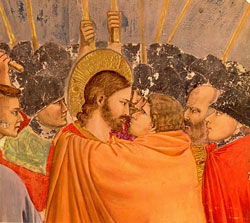
Avery Cardinal Dulles wrote an article entitled "The Population of Hell" in part based on this saying of Jesus about Judas that it would have been better for him to have never been born. He uses it to say that maybe we can, in fact, say that there are some people in hell. Otherwise, how could what Jesus says possibly be true? This is truly a harrowing thought.

There is a flip-side to this frightening notion, though. What we see here is Jesus continuing to choose Judas even though he knows that Judas will betray him. Right to the very end, Jesus doesn't give up on Judas. This is a source of great hope for us. In Jesus Christ, we have a master and teacher who chooses such disciples as Judas and Peter. We have a master and teacher who is always making a choice on our behalf no matter what. There is no way we can fall so far that we get beyond his reach, there is nowhere we can fall that we can't be caught… so long as we let ourselves be caught.

Glory to Jesus Christ! Glory Forever!

~J

Saturday, April 11, 2009

Lend a Glimpse of Christ

Last Wednesday's readings can be found here.

There is a story about one of Mother Theresa's sisters questioning the amount of prayer she had prescribed for the order. It goes something like this: "Mother," she said, "I can already see Christ in the people we serve. I wish I had more time to do more for them." "My daughter," answered Mother Theresa "our prayer is not for us to see Christ in our people, but so that they might recognize Christ in us."

In this gospel, the central problem is a failure on the part of the people to truly recognize Christ for who he really was. Yes, they see him. Yes, they think they know him. But they do not recognize him as the Son of the Father they claim God to be. They fail to recognize their most dear brother.

Of course, this situation is not confined to the past. Our world today fails again and again to recognize Christ. But if we would say that we truly love Christ, then wouldn't we want to be able to recognize him everywhere that he was? Furthermore, if we are truly grateful for what Christ does in our lives, then shouldn't we want those we love to see him as well? If we do, it seems there are two ways this can happen: we can point him out, and we can reflect his image.

I think this latter method, above all else, is what God wants of us who are privileged to receive the Eucharist every day. Our status as beloved sons and daughters of God demands that we take on one another as beloved sisters and brothers. What greater act of love can we make than to help them to see the Jesus we receive each day?

Glory to Jesus Christ! Glory Forever!

~J

Monday, March 30, 2009

The Annunciation of the Lord

Readings for the Solemnity of the Annunciation

When I picture this scene between Mary and the angel Gabriel, I see something very dramatic. I think at least on some level, Mary must have understood what was being asked of her, what would be riding on her shoulders. She must have had a sense at least that her boy would be no ordinary boy, but that somehow in him would be the salvation of the world. I find myself wondering, "How did she have the strength to say 'yes' to that?!" How could she give her consent to such an extraordinary task?

Yet, it occurs to me that we stand in Mary's position each time we come to the altar for Eucharist. We take into our very bodies the power that saves the world and we carry him out beyond the walls of the church to our friends and neighbors. The key to understanding this mystery, though, is not that Mary's "fiat" was as routine as our "Amen" can become if we let it, but that our "Amen," each time we receive the Eucharist, is as monumental as Mary's fiat. Both Gabriel's message and the message "The Body of Christ" are to be received with open hands and open heart.

Glory to Jesus Christ! Glory Forever!

~J

Thursday, March 19, 2009

What Can I Offer?

Normally, I would just post the homily I gave at the daily Mass, but today it would make more sense for this post if I start off describing what I did.

They teach us in seminary that there are three reasons to preach: to delight, to teach, and to persuade. Any preacher can, and ought, to rely on the Holy Spirit to supply the right inspiration for the first and the last of those goals, but teaching is very much dependent on the knowledge one has "up there." I found myself seriously questioning what I could possibly teach to the daily Mass crowd here at St. Peter's in Saratoga. Like most daily Mass congregations, they all know way more than I do about life. On top of that, most of the things I know that they don't, they wouldn't really want to know anyway! Then, I had an idea…

As a part of the internship program, I have to look over the statistics for the parish and send a profile back to Mundelein. One of the things I learned was that only about a third of the people registered at St. Peter's attend Mass regularly. (They have just over 3,000 registered parishioners, and they're average weekend Mass attendance is around 1,000.) It occurred to me that this probably weighs on the minds of the daily Mass goers. It also occurred to me that the majority of the people in the parish who don't go to Mass are around my age. So… I got my idea for what I could teach: I can share the insights, arguments, and stories that have made sense to me, touched me, and my friends, and have kept me in church so that they can in turn share them with their friends and neighbors.

Today's Readings were from Deuteronomy and the Gospel According to St. Matthew.

The other night I was leading a discussion group for the 11th-graders preparing for confirmation here at St. Peter's. I asked them to share their thoughts with me on Jesus and the Church. One girl said something to the effect of, "Well… I like Jesus… he talks about peace and being a good person. But it seems like the Church is just about rules and regulations." Today's gospel reading, in fact, highlights Jesus' relationship to rules and sheds light even on the relationship between him, the mission he gives us, and his Church.

Here's what people have said that make sense to me. First of all, Christian discipleship looks like something. The ten commandments, for instance, show us the bare minimum of what loving God and loving our neighbor looks like. In other words, Jesus never tells us to do something without first showing us how. Second, he never asks us to do anything alone, he has given us the gift of the Church to support our discipleship.

That works for me… maybe you'll find it helpful too.

Glory to Jesus Christ! Glory Forever!

~J

Thursday, March 5, 2009

Signs for Every Generation


Wednesday's readings were from Jon 3:1-10; Ps 51:3-4, 12-13, 18-19; and Lk 11:29-32.

"This generation is an evil generation; it seeks a sign…" Jesus laments at the beginning of our gospel reading today. It occurs to me, though, that it is part of human nature to look for signs, to look for proof, especially when it comes to divine matters. In every generation, people want proof that Jesus Christ was who he claimed to be and that his teachings are valid, worth following.

Today, we commemorate St. Casimir, and I want to share with you a snippet from an account of his life. St. Casimir was a prince, and this is what someone wrote of him:

By the power of the Holy Spirit, Casimir burned with a sincere and unpretentious love for almighty God that was almost unbelievable in its strength. So rich was his love and so abundantly did it fill his heart, that it flowed out from his inner spirit toward his fellow men. As a result, nothing was more pleasant, nothing more desirable for him, than to share his belongings, and even to dedicate and give his entire self to Christ's poor, to strangers, to the sick, to those in captivity and to all who suffer. To widows, orphans and the afflicted, he was not only a guardian and patron but a father, son and brother.

I ask you: if you could have met St. Casimir, would have been inclined to believe what he had to say about Jesus Christ? As you looked at the example of his life, would it not have been easy for you to believe in Christ's teachings? Was he not a "sign" to his generation?

The discipline and penance we follow in Lent is meant to empty us out—to make the most room for what Jesus wants to give us. When we allow this to happen—allow ourselves to be filled completely with what Jesus wishes to give us—our very lives become proof and validation for the person and teachings of Jesus Christ. We give our loved ones the sign the long for so desperately.

Glory to Jesus Christ! Glory Forever!

~J

Saturday, February 28, 2009

A Belated Reflection…


Over the last Christmas break, the seminarians of Albany got to make a pilgrimage to Rome and Assisi. It was a truly wonderful experience for all of us which will undoubtedly bear much fruit well into the future. Below is a little reflection on one thing I gleaned from the experience and what impact I think it might have on my current and future ministry in the diocese of Albany.

I had never really thought much about what Rome meant as the city of Ss. Peter and Paul, but after encountering Rome through this lens, I have a new perspective on the entire Christian life and its ultimate goal.  I am struck by how these two saints almost seemed to see the culmination of their ministry of evangelization in preaching to the people of Rome.  It's almost as if the Holy Spirit saw Rome as the most fertile ground to plant the seeds of these two martyrs' lives.  As we walked about in the churches housing their relics and the relics of literally thousands of other martyrs who followed in their footsteps, all the while surrounded by the ruins of the city that their faith transformed, I was overwhelmed by the concrete masterpiece of God's providence.


In our seminary formation, much is said about the need for us to become ever more configured to Christ, the King who reigns from the throne of the cross.  Our formators tell us frequently about the need to develop a spirit of self-sacrifice and endless generosity in order to be good priests.  In principle, I have never disagreed, but as I reflect on what I have now seen with my own eyes in Rome, I realize that Rome itself is a proof that our hope in the Lord's grace is never in vain.  When one considers the supreme sacrifice made by both Peter and Paul, the uncertainty and trauma that their deaths must have imparted to their fledgling churches, the thousands of people who would be inspired to follow in their footsteps over the following centuries, how those acorn churches they founded have grown into mighty oaks… there is indeed cause for rejoicing here.

I think this is the most important impact the pilgrimage will have on my ministry at home.  It strikes me that people in our diocese have so little to look forward to.  According to recent surveys, a majority of them are so unsatisfied with their lives in New York State, they would move if they could, but are tied to the area by inadequate finances, family situations, or lack of employment opportunities.  The prospects our economy offers are grim, at best.  Then, there is the very painful process of Called-to-be-Church which many have nick-named "Called-to-be-Closed," embodying the disillusionment of so many people who had always thought their parish church—with its own priest—would always be there waiting for them whenever they needed it.  What I see my people facing at home, then, is a multitude of challenges to having real hope in Christ.  There are so many occasions at home to become discouraged, cynical and skeptical about the future, but our people need to see that our hope in Christ's promises is never in vain.  Before I would ever be able to impart that hope to my people, however, I would first have to be convicted in that hope myself; this is what the pilgrimage experience has done for me.  As I look at the examples of Peter, Paul, and the countless martyrs who followed them, I can have hope that my devotion to the people of God in the Albany diocese will not be in vain, that it will actually be helpful and fertilize the seeds of faith others planted generations ago.  In a way I could not before, I can now preach hope in Christ with my life.


Glory to Jesus Christ! Glory Forever!

~J