Wednesday, April 15, 2009

The Proof is in the Pudding

Today's scripture can be found here.

Another teaching homily for today, again, something we can say not to those who aren't here, but to those who won't come.

Those of us who are believers in Christ today don't really get to see Christ with our own eyes, but we do get to see his power working in Christian life—our life as a community and as individuals. I once read a book of Russian theology, and the author used this analogy. If we think of a soap bubble, of all its iridescent colors, its perfectly round shape, etc., we realize that the bubble's existence is proof that there is air inside. We can't see the air, but without it, we would have nothing but a puddle of soap. This is what the presence and the power of God is like in our lives.


You see, we're supposed to be like the man Peter and John heal in the account from Acts. People should be able to look at us over time and ask, "What happened? How did they get like that? Why did they get like that?" In my case, for example, ten years from now, people should be able to look at me and see a good, generous priest and ask, "What happened?! He used to be such a tightwad!" Now, it does sometimes happen that we get to see miraculous physical healings, but what people should be able to see is the spiritual healing we receive. Over time, people should be able to see us becoming more and more like Christ: more loving, more forgiving, more generous, and so forth.

But as in today's gospel, the most astonishing realizations of God's power happen when we gather together as a community of disciples, break open the Word, and share his body. This is why we gather at the altar for the Eucharist. Just think about all the wonderful things that happen around the altar. These things are what we need to point out to those who would debunk what happens at the altar.

Christ is Risen! Indeed He is Risen!

~J

Tuesday, April 14, 2009

Hope: Laying it on the Line

Last Wednesday's reading can be found here.

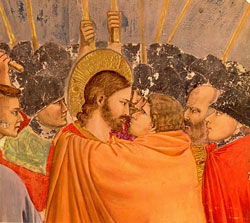
Matthew gives a vision of Jesus, I think, as someone who frequently lays things right on the line and forces people to make a choice. This gospel passage really lays it on the line today; it reminds me of one of the old Looney Tunes cartoons where the villain sharpens an ax and then plucks a hair from his head and splits it on the sharpened edge.

Avery Cardinal Dulles wrote an article entitled "The Population of Hell" in part based on this saying of Jesus about Judas that it would have been better for him to have never been born. He uses it to say that maybe we can, in fact, say that there are some people in hell. Otherwise, how could what Jesus says possibly be true? This is truly a harrowing thought.

There is a flip-side to this frightening notion, though. What we see here is Jesus continuing to choose Judas even though he knows that Judas will betray him. Right to the very end, Jesus doesn't give up on Judas. This is a source of great hope for us. In Jesus Christ, we have a master and teacher who chooses such disciples as Judas and Peter. We have a master and teacher who is always making a choice on our behalf no matter what. There is no way we can fall so far that we get beyond his reach, there is nowhere we can fall that we can't be caught… so long as we let ourselves be caught.

Glory to Jesus Christ! Glory Forever!

~J

Saturday, April 11, 2009

Lend a Glimpse of Christ

Last Wednesday's readings can be found here.

There is a story about one of Mother Theresa's sisters questioning the amount of prayer she had prescribed for the order. It goes something like this: "Mother," she said, "I can already see Christ in the people we serve. I wish I had more time to do more for them." "My daughter," answered Mother Theresa "our prayer is not for us to see Christ in our people, but so that they might recognize Christ in us."

In this gospel, the central problem is a failure on the part of the people to truly recognize Christ for who he really was. Yes, they see him. Yes, they think they know him. But they do not recognize him as the Son of the Father they claim God to be. They fail to recognize their most dear brother.

Of course, this situation is not confined to the past. Our world today fails again and again to recognize Christ. But if we would say that we truly love Christ, then wouldn't we want to be able to recognize him everywhere that he was? Furthermore, if we are truly grateful for what Christ does in our lives, then shouldn't we want those we love to see him as well? If we do, it seems there are two ways this can happen: we can point him out, and we can reflect his image.

I think this latter method, above all else, is what God wants of us who are privileged to receive the Eucharist every day. Our status as beloved sons and daughters of God demands that we take on one another as beloved sisters and brothers. What greater act of love can we make than to help them to see the Jesus we receive each day?

Glory to Jesus Christ! Glory Forever!

~J